Young Washington: How Wilderness and War Forged America's Founding Father by Peter Stark
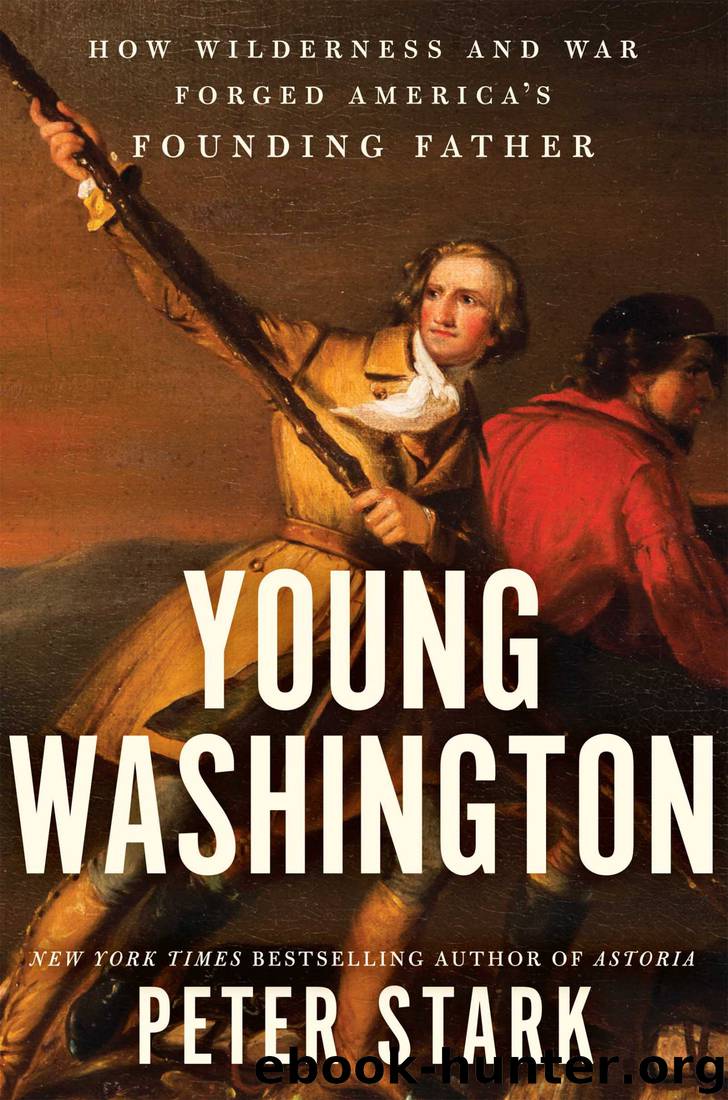
Author:Peter Stark
Language: eng
Format: epub
Tags: Colonial Period (1600-1775), History, Revolutionary, United States
Publisher: HarperCollins
Published: 2018-03-27T00:00:00+00:00
Part Three
Chapter Fifteen
JAMES SMITH WAITED ANXIOUSLY AT FORT DUQUESNE ALL that afternoon. The battered eighteen-year-old captive hoped to hear that General Braddock’s army had decimated the French and Indian forces. The news was not good for the captive Smith, however. A runner arrived at the fort that afternoon with the message that the Indians, hiding behind trees and in gullies, had surrounded General Braddock and kept up a constant fire. The English were “falling in heaps.”
As Smith recorded,
Some time after this, I heard a number of scalp halloo’s and saw a company of Indians and French coming in. I observed they had a great many bloody scalps, grenadiers’ caps, British canteens, bayonets &c. with them. They brought the news that Braddock was defeated. After that another company came in which appeared to be about one hundred, and chiefly Indians, and it seemed to me that almost every one of this company was carrying scalps; after this came another company with a number of waggon-horses, and also a great many scalps. Those that were coming in, and those that had arrived, kept a constant firing of small arms, and also the great guns in the fort, which were accompanied with the most hideous shouts and yells from all quarters; so that it appeared to me as if the infernal regions had broke loose.
Some of the victorious Indian warriors, Smith noted, donned full British officers’ dress, including half-moon gorgets and laced hats. Some surely wore as trophies the massacred grenadiers’ mitre caps—tall and conical, covered in back with a rich red fabric and shimmering gold in the front, emblazoned with the swirling initials GR for Georgis Rex, or King George, and the emblem of a galloping steed that symbolized his House of Hanover, along with the motto Nec Aspera Terrent—Difficulties daunt us not.
While the Indians at Fort Duquesne celebrated wildly, one British survivor of the slaughter, Duncan Cameron, still lay on the battlefield. After taking a musket ball early in the action, he had fallen stunned on the hillside where the battle began and was left for dead. When the British retreated toward the Monongahela River ford in the face of overwhelming fire and tomahawk attacks, Cameron came to consciousness. The woods around him appeared deserted except for the corpses of the British soldiers, the dead horses, the abandoned cannon. He stumbled away from the sprawled bodies and into the forest, where he found a large hollow tree, probably a giant sycamore, which often grow with hollow centers large enough to easily shelter a human. He crawled into the hole and hid.
. . . I had not been there long before these ravenous Hellhounds came yelping and screaming like so many Davils, and fell to work [scalping]. . . . About a Foot above the Entrance into the Tree I was in there was a good Foot-hold for me to stand on . . . and against my Face there was a small Knot-hole facing the Field of Battle, by Means of
Download
This site does not store any files on its server. We only index and link to content provided by other sites. Please contact the content providers to delete copyright contents if any and email us, we'll remove relevant links or contents immediately.
| Africa | Americas |
| Arctic & Antarctica | Asia |
| Australia & Oceania | Europe |
| Middle East | Russia |
| United States | World |
| Ancient Civilizations | Military |
| Historical Study & Educational Resources |
Cat's cradle by Kurt Vonnegut(15365)
Pimp by Iceberg Slim(14522)
4 3 2 1: A Novel by Paul Auster(12403)
Underground: A Human History of the Worlds Beneath Our Feet by Will Hunt(12101)
The Radium Girls by Kate Moore(12035)
Wiseguy by Nicholas Pileggi(5795)
The Fire Next Time by James Baldwin(5454)
Perfect Rhythm by Jae(5410)
American History Stories, Volume III (Yesterday's Classics) by Pratt Mara L(5312)
Paper Towns by Green John(5195)
Pale Blue Dot by Carl Sagan(5013)
A Higher Loyalty: Truth, Lies, and Leadership by James Comey(4966)
The Mayflower and the Pilgrims' New World by Nathaniel Philbrick(4508)
The Doomsday Machine by Daniel Ellsberg(4493)
Killers of the Flower Moon: The Osage Murders and the Birth of the FBI by David Grann(4451)
The Sympathizer by Viet Thanh Nguyen(4398)
Too Much and Not the Mood by Durga Chew-Bose(4353)
The Borden Murders by Sarah Miller(4330)
Sticky Fingers by Joe Hagan(4207)
